
Published 18 July 2026
Last updated: July 2026. Compiled from official UK government, NHS and industry sources.
16.7 million people in the UK are disabled, and mobility problems are the most common impairment they report. This page brings together the latest figures from the ONS, DWP, NHS England, the Department for Transport and industry bodies, covering disability prevalence, falls, wheelchairs, stairlifts, mobility scooters and home adaptations.
Key figures
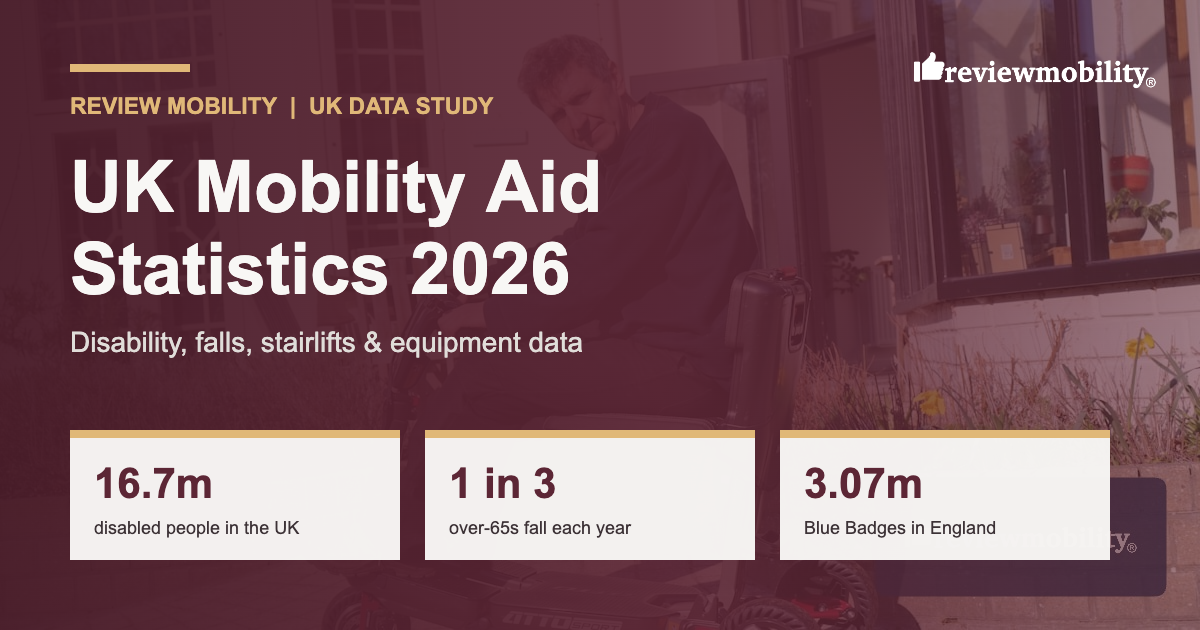
- 16.7 million people in the UK are disabled. That is one in four, up from 12.9 million a decade ago (Family Resources Survey 2024/25)
- Mobility is the most common impairment among disabled pensioners, reported by 68%. Among disabled working-age adults the figure is 40%
- Around 1.2 million people in the UK use a wheelchair, two thirds of them regularly
- 3.07 million Blue Badges were held in England as of March 2025, or 5.2% of the population
- Around one in three people over 65 fall each year, and about half of people over 80
- Falls in over-65s caused around 210,000 emergency hospital admissions in England in 2022/23. Falls and fractures cost the NHS an estimated £2 billion a year
- The UK stairlift and climbing device market generated about US$206.5 million in 2023
- The Disabled Facilities Grant budget for England is £711 million a year in 2024/25 and 2025/26
Disability and mobility impairment in the UK
One in four people in the UK are disabled: 16.7 million in the 2024/25 Family Resources Survey, up from 12.9 million (20%) in 2014/15. The number of disabled women rose from 7.0 million (22%) to 9.2 million (27%) over that decade, and disabled men from 5.9 million (19%) to 7.5 million (22%).
Among disabled pensioners, 68% report a mobility impairment, the most common impairment type for that age group. Among disabled working-age adults the figure is 40%, second only to mental health impairments at 46%.
Disability rates vary by region. Scotland has the highest rate at 30% of the population, followed by Wales at 26% and Northern Ireland at 22%. London has the lowest at 17%. The UK average is 25%.
6.9 million people in Great Britain were entitled to a disability benefit in May 2025, or 10.8% of the population, up from 4.4 million (7.4%) in May 2005 (House of Commons Library).
The UK’s ageing population
13.4 million people in the UK were aged 65 or over in 2025. The ONS projects this will rise 34% to 18 million by 2050, and the number of people aged 75 and over is expected to roughly double from 5 million to nearly 10 million by 2039. On current projections, over-65s could make up 27% of the population by 2072, and the ratio of working-age adults to each person over 65 is expected to fall from 3.1 to 2.4.
Falls among older people
- Around one in three people aged 65 and over fall at least once a year, and around half of people aged 80 and over (NICE)
- There were around 210,000 emergency hospital admissions related to falls among over-65s in England in 2022/23 (Office for Health Improvement and Disparities)
- 57% of UK hospitals reported an increase in elderly falls last year, and 90% of NHS trusts have seen emergency admissions for over-65s rise since 2022 (Taking Care, 2025)
- Falls and fractures in older people account for over 4 million hospital bed days a year in England, at an estimated cost of £2 billion
- Unaddressed fall hazards in the home are estimated to cost the NHS in England £435 million a year (gov.uk)
Hip fractures
- Around 72,000 to 75,000 people a year suffer a hip fracture in the UK (National Hip Fracture Database, 2025 report)
- The average hip fracture patient is 83 years old, and about 73% are women
- Hip fracture patients occupy 1 in 30 NHS hospital beds. Average inpatient costs were £14,465 per patient in the year after fracture (University of Bristol REDUCE study)
Wheelchair use in the UK
- The NHS estimates around 1.2 million wheelchair users in the UK, roughly 2% of the population, with two thirds classed as regular users. This estimate has not been revised since 2015
- NHS England’s National Wheelchair Data Collection publishes quarterly figures on registered users of NHS wheelchair services, referral-to-delivery times and spending. The latest covers April to June 2025
- 860,000 people were on the Motability Scheme at the end of March 2025. Around 56% of customers use or have used a wheelchair, and the scheme includes over 35,000 wheelchair accessible vehicles (Motability)
Blue Badge statistics
- 3.07 million valid Blue Badges were held in England as of March 2025, or 5.2% of the population, up 228,000 (8.0%) on the previous year (Department for Transport)
- 1.27 million badges were issued in 2024/25, a 12.3% rise on the previous year
The UK stairlift market
- The UK market for stairlifts and climbing devices generated about US$206.5 million in revenue in 2023. Forecasts put annual growth at about 8.8% to 2030, reaching around US$373.3 million (Mordor Intelligence / Research and Markets)
- Acorn Stairlifts manufactures over 70,000 stairlifts a year in its UK factories and reported turnover of £255.8 million
- A straight stairlift typically costs £1,800 to £5,500 in 2025/26, with most installations between £2,500 and £4,000. Curved stairlifts cost £3,800 to £10,000, most often £5,000 to £7,000
- Installation adds £300 to £600 for a straight stairlift (2 to 4 hours of work) and £600 to £1,500 for a curved model
Our stairlift cost calculator turns these ranges into an estimate for your own staircase.
Mobility scooters
- The most recent robust estimate put 300,000 to 350,000 mobility scooters in use in the UK in 2017 (ClinMed International Library)
- The wider UK mobility devices market is projected to grow from US$754.7 million in 2023 to US$1,152.2 million by 2030 (Fortune Business Insights)
Home adaptations and the Disabled Facilities Grant
- Government funding for the Disabled Facilities Grant (DFG) in England is £711 million a year for 2024/25 and 2025/26
- The DFG funds stairlifts, level-access showers and wet rooms, ramps, wider doorways, wash-dry toilets and home extensions, up to £30,000 per grant in England
- Half of all DFG grants in 2023/24 were between £5,000 and £15,000, up from about 35% before 2020. Grants over £15,000 rose from 8% in 2020/21 to 10%
Methodology and sources
Figures on this page are taken from the latest available official publications as of July 2026. Where a statistic has not been revised since it was first published, such as the NHS wheelchair users estimate, we say so. Figures for childhood disability are on our disabled children statistics page. Definitions of the equipment terms used on this page are in our mobility aids glossary.
Sources:
- Family Resources Survey 2024/25, DWP
- UK disability statistics: prevalence and life experiences, House of Commons Library
- The UK’s changing population, House of Commons Library
- Falls: applying All Our Health, GOV.UK
- Falls guideline, NICE
- Elderly falls and healthcare report, Taking Care (2025)
- National Hip Fracture Database 2025 annual report
- National Wheelchair Data Collection Q1 2025/26, NHS England
- Motability Scheme customer factsheet
- Blue Badge scheme statistics April 2024 to March 2025, DfT
- Disabled Facilities Grants for home adaptations, House of Commons Library
- Europe stair lift market, Mordor Intelligence
- UK mobility devices market, Fortune Business Insights
Published 18 July 2026
Cite this page
Free to reuse with credit to Review Mobility (CC BY 4.0). A link back is appreciated.